
NASA Contractor CMMI
✨
NASA Contractor CMMI ✨
Service Design Case Study
Developing and Implementing CMMI-Conforming Processes for an 8(a) NASA Contractor
🔎 Research Categories: Generative, Evaluative
📝 Project Type: CMMI Certification (Frontstage & Backstage Service Design)
🕵️♀️ Role/Contribution: Project Manager, Service Designer, UX Researcher
🗓️ Timeline: 15 months
🛠️ Relevant Tools: Miro, Microsoft SharePoint, Microsoft Word, Microsoft Excel, Microsoft Outlook
🤝 Cross-Functional Team Size: 10
👥 Stakeholders Involved: 20
🔒 Users: 115 internal users
*Note: The visuals on this page were created for this case study.
🎯 Business Outcomes:
Increase eligibility to bid on NASA contracts by attaining CMMI Level 3.0 Certification for the company
Enhance scalability of the company to support onboarding of new employees in case of contract award
🥅 High-Level Project Objectives:
Design a meaningful and usable Quality Management System (QMS) on SharePoint
Develop and implement streamlined corporate procedures and processes
Jump to…
Project Context
What is CMMI?
The Capability Maturity Model Integration (CMMI), originally developed over a 10-year period at Carnegie Mellon University (CMU) to evaluate the quality and capability of software contractors for the DOD, is now used by diverse organizations, including government agencies like NASA, to assess a company's level of maturity. It is sometimes a requirement for contract proposals.
Problem Statement
As we work towards attaining CMMI 3.0 compliance, we need to create a corporate process structure that is user-friendly and accommodates the requirements of all stakeholders in order to position the company for future growth opportunities while also improving employee experiences.
Service Design Goals
Develop processes and procedures around 24 different practice areas with required documentation (called artifacts), including procedure documents, corporate plans, related forms, tracking matrices, etc.
Design a functional Quality Management System (QMS) site on SharePoint to organize all corporate processes and related documentation
Accomplish CMMI Level 3.0 Certification by end of 2021

Actionable Insights
-
By designing corporate processes that mirror familiar NASA workflows, we minimized the learning curve for 90% of our user base who are NASA contract employees. This alignment ensured CMMI compliance while preventing employees from needing to juggle two disparate systems throughout their workday, ultimately enabling faster adoption and reducing errors.
-
NASA employees lacked clear channels to reach the corporate office for questions about benefits, pay, and HR matters. We established dedicated communication avenues documented across our Governance Plan, Process Quality Assurance, and Process Asset Development procedures. Implementing an annual anonymous employee survey created an additional feedback loop to surface issues that might otherwise go unheard, ensuring employees could get timely answers to their questions.
-
As a subcontractor, our benefits package needs to match or exceed the prime contractor's offerings since employees don't choose between prime and sub when applying to NASA contracts. Using our updated Decision Analysis & Resolution process, we analyzed past training initiatives and identified a cost-effective solution: launching a year-long LinkedIn Learning trial as a core benefit, with quarterly surveys to measure adoption and value. This positioned us more competitively while managing costs strategically.

Business Impact
The CMMI and ISO certifications I led unlocked X3M's eligibility to bid as prime contractor on NASA's largest contract at Goddard Space Flight Center, valued at $354M.
The company will be eligible to bid more contracts since many government contracts require CMMI and/or ISO certification. CMMI is also a significant differentiator in the competitive government contracting landscape. This promotes company growth through opening up bidding eligibility. As a small 8(a) company with a lean corporate office, using CMMI to develop and implement our organization's processes and procedures has provided needed structure to the business.
Update: Though I left the company in 2022, I learned in 2025 that they are bidding on the largest contract (valued at $354M) at NASA Goddard Space Flight Center as a prime contractor. This was made possible by the CMMI (and ISO) work I spearheaded. Big win! 🥇
Service Design Impact

Strategic Impact
Attaining CMMI certification positioned X3M to scale sustainably accounting for present and future rapid growth of its workforce.
In 2020, the business grew and onboarded about 2/3 of its current employee base after becoming the subcontractor on a contract. Due to this rapid growth, X3M needed to revisit the inner workings of the business to be able to sustain future growth and large-scale onboarding. This led to the decision to pursue CMMI 3.0 certification. Because we passed and received CMMI certification, we are on track to spend much of 2022 on Business Development and pursuing new contracts. One contract X3M is bidding on in early 2022 requires CMMI and would lead to onboarding ~2,000 new employees upon the contract start date. CMMI has allowed X3M to be able to handle that influx of new employees efficiently.
User Impact
Employees gained meaningful agency in shaping company processes, resulting in actionable feedback we wouldn't have captured through traditional channels alone.
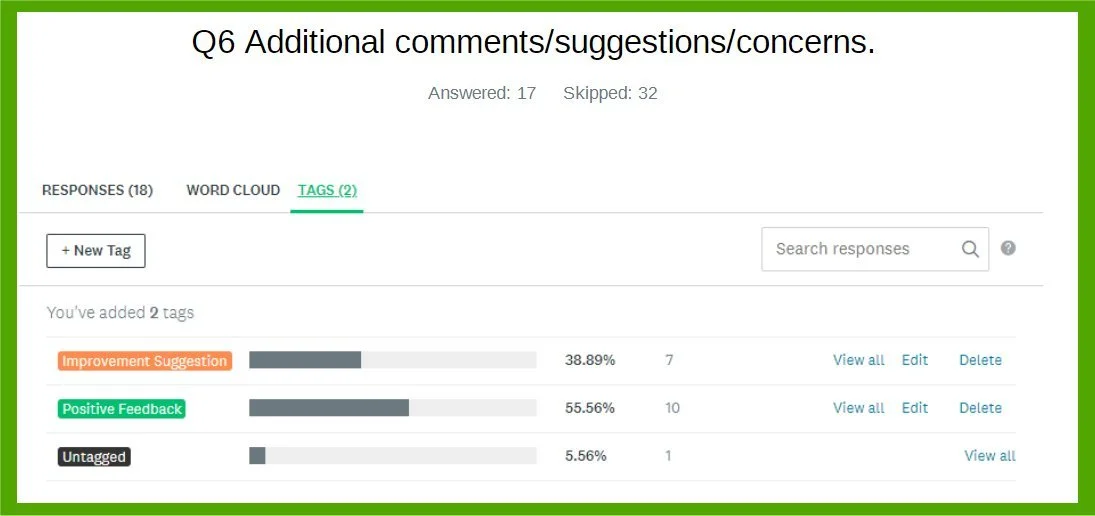
Our users, the employee base, have more ways to interact with and impact the company such as Process Improvement Requests (PIRs), Causal Analysis & Resolution (CAR) Reports, and more. Through our CMMI implementation efforts, we also enacted a new, anonymous Employee Satisfaction Survey to be administered annually. We received many helpful process improvement suggestions that we may have never received had we expected our users to find and fill out a Process Improvement Request (PIR) form.
Key Methodologies
The principles of service design most at play were:
Human-Centered, Collaborative, Holistic, Iterative
-
Researched CMMI, its purpose, and how it can fit in within our organization. This heavily influenced the implementation of the CMMI model to fit our organization as well as the design of our Quality Management System (QMS).
-
Interviewed stakeholders such as the company’s COO, President, and VP to better understand business goals tied to CMMI.
Met with frontstage users (employees) in groups to understand their needs as well as additional constraints and considerations (such as comparable NASA processes already in place). Users invited to the focus groups included project managers, resource analysts, HR, etc. -
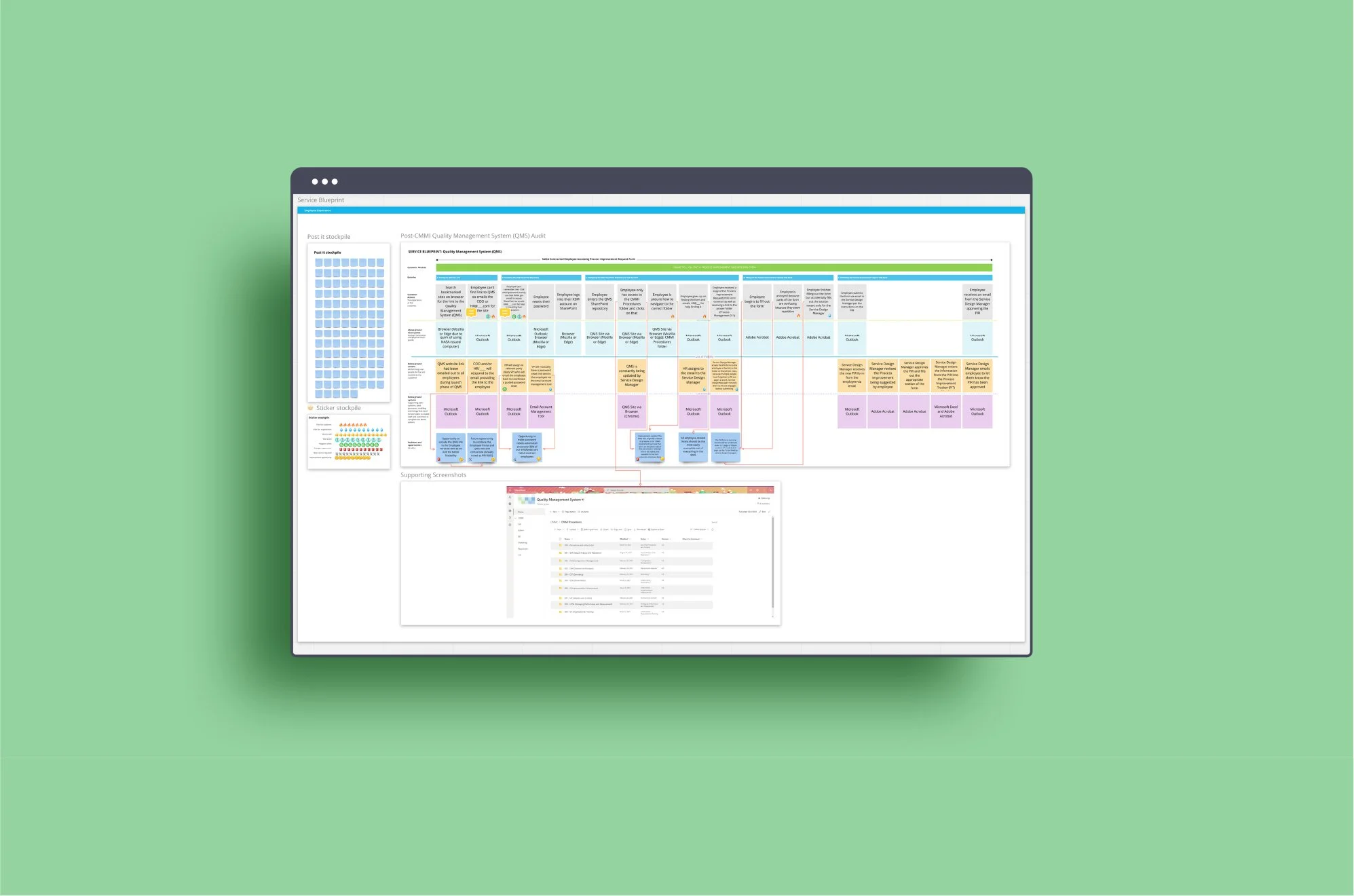
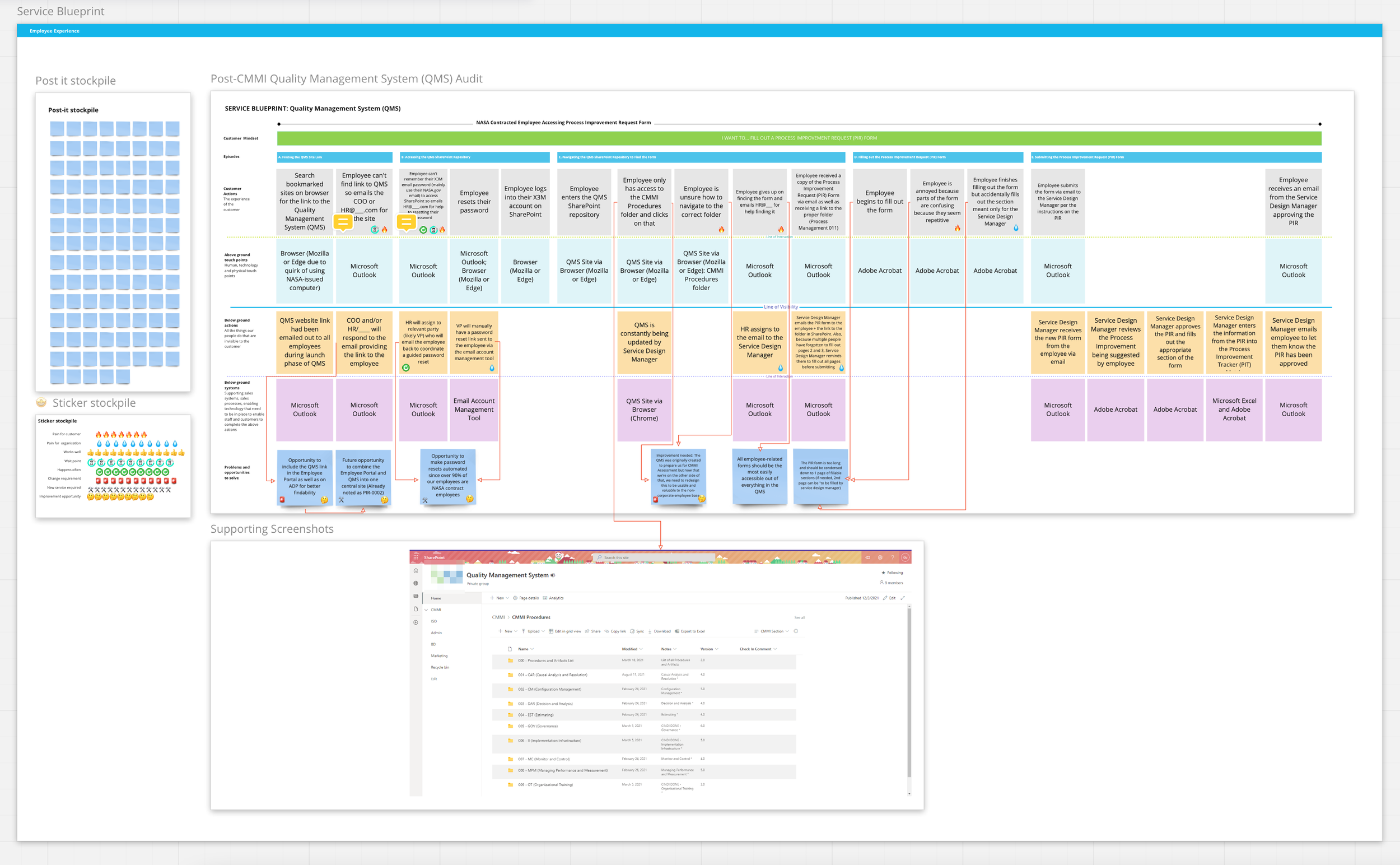
Visualized the relationships between different service components (frontstage and backstage) to uncover pain points and process improvement opportunities.
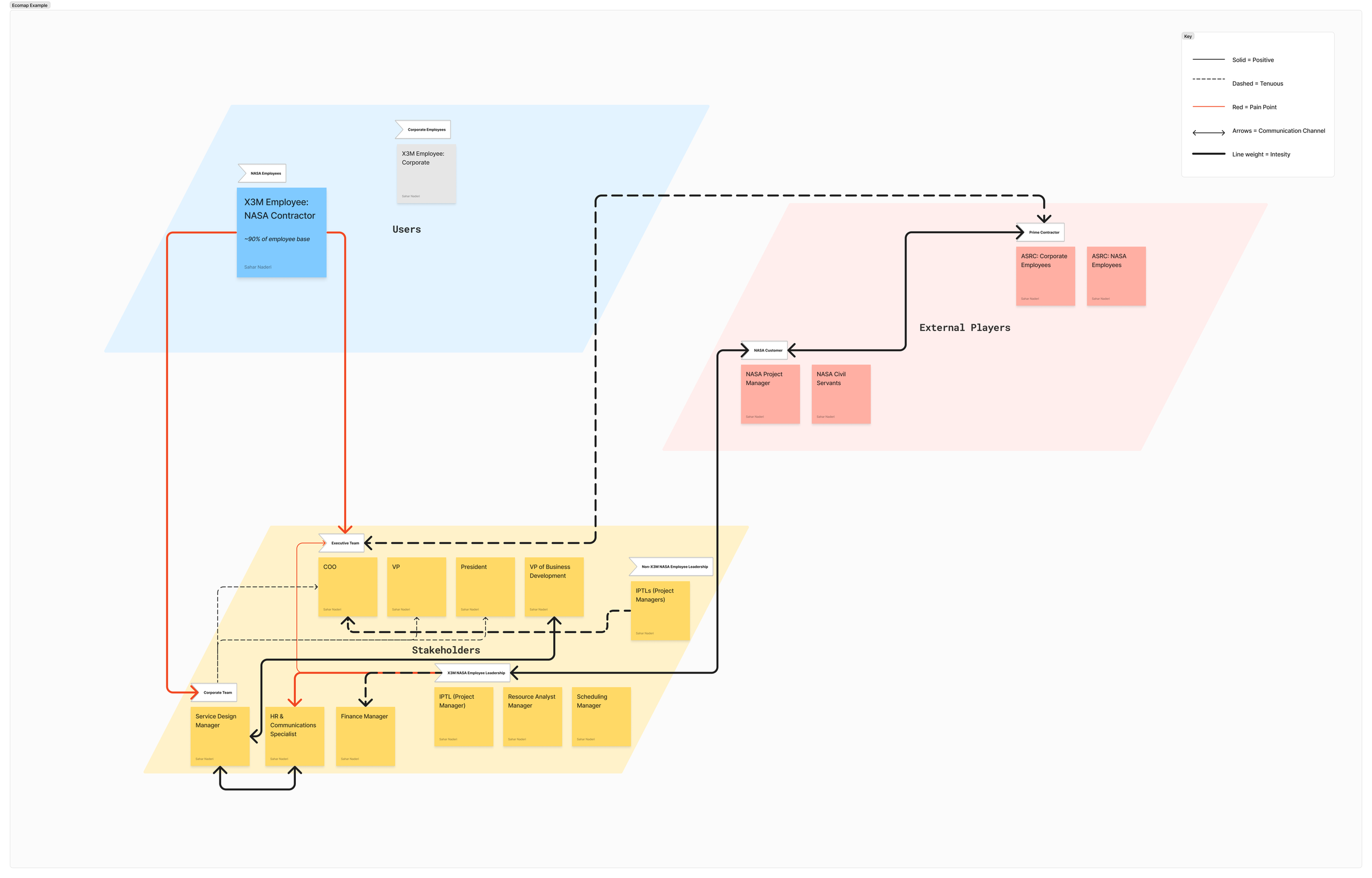
Highlight pain points in the communication channels between all backstage and frontstage players (Users, Stakeholders, & External Players) by mapping user relationships.
-
Despite the need for a quick SharePoint build at the start of the project, I devoted significant time to the Information Architecture (IA) of the Quality Management System (QMS) prototype. I created user flows, paper prototypes, and approached the QMS as a living product that could be continuously iterated upon.
Reflections & Learnings
-
Cross-functional partnership requires speaking everyone's language. Literally.
Leading certification efforts meant translating between executive priorities, technical requirements, NASA contract language, and employee day-to-day realities. Effective stakeholder management required understanding what each audience cares about and connecting the work to their specific goals. This skill became foundational to how I approach research storytelling and strategic communication in every role since.
-
Translating frameworks into practice requires interpretation, not replication.
CMMI provided the requirements, but our Quality Management System needed to serve our specific organizational context – a small 8(a) NASA contractor with a lean corporate office and field-heavy workforce. The most successful implementations weren't literal translations of the model, but thoughtful adaptations that preserved intent while fitting our reality. This taught me that compliance and usability aren't at odds when you focus on outcomes over outputs.
-
Service design operates at the intersection of multiple disciplines, and its power lies in that convergence.
This project required me to approach this service like a researcher (understanding user needs), an information architect (structuring complex systems), a configuration manager (maintaining version control and dependencies), and a database administrator (ensuring data integrity). The most elegant solutions emerged when I could synthesize insights across these lenses rather than treating them as separate concerns. This multidisciplinary approach became a defining characteristic of how I lead strategy work today.