My Leadership Philosophy 🧐
As Product Strategy Director at a global UX agency, I lead across three dimensions: building and developing teams, managing complex client relationships, and driving business growth.
These responsibilities are deeply interconnected. Quality client work requires strong teams, business development relies on proven delivery, and team development depends on meaningful project opportunities.
I lead by building systems that scale while growing humans who flourish, driving business results while protecting team wellbeing, pushing for uncomfortable evolution while creating psychological safety. The best leadership learns to hold all of these as equally important.
Pragmatism Meets Heart
Strategy
Resource Allocation: I strategically match team members to projects based on both client needs and individual growth trajectories, ensuring we deliver excellent work while creating opportunities for people to develop skills aligned with their career goals.
Business Development & Retention: I approach client relationships and new business as extensions of relationship-building (which is an important prong of being a strategic researcher).
Strategic Prioritization: I make difficult decisions about which opportunities to pursue and which to decline, weighing factors like team capacity, strategic fit, growth potential, and alignment with our craft values to protect both quality and team wellbeing.
Measurement & Impact: I build frameworks that connect our craft work to tangible business outcomes, translating research and strategy value into metrics that matter to both clients and leadership.
I lead with both head and heart,
balancing business realities, client needs, and team wellbeing to create opportunity and growth.
People
Intentional Evolution: I guide team members through uncomfortable growth by staying attuned to where our industry is headed and translating those shifts into development opportunities. I push individuals to evolve their capabilities while simultaneously elevating our entire craft, preparing the team for the future of the work, not just today's needs.
Balanced Transparency: I practice honest, open communication while avoiding the trap of oversharing. I provide context and clarity without overwhelming the team with half-baked information or unnecessary anxiety about things outside their control.
Coaching Across Contexts: I mentor and develop both internal team members (helping them build research and strategy capabilities) and client stakeholders (guiding them toward better UX maturity, research democratization, and evidence-based decision-making).
Strategy Meets People
Stewardship: I approach leadership as both caretaking and infrastructure development by building programs, processes, and operational systems (applying my service design background) that outlast my tenure and leave both our agency's research function and our clients' organizations stronger and more capable than I found them.
Direction-Setting: I connect day-to-day strategy work to meaningful business impact by articulating clear vision, explaining why our work matters, and helping everyone understand how their contributions create measurable value for clients and the organization.
Relationship-Building as Core Competency: Whether I'm developing internal team dynamics, managing complex client partnerships, or pursuing new business opportunities, success comes down to genuine human connection. That means understanding what people care about and building trust through consistent delivery and authentic engagement.
Value Props: Leadership Case Study
Leading Through Ambiguity:
Building the Research Team’s 1st Value Propositions
🗯️ The Challenge: After taking over as the head of the Research Team, it became clear that our craft lacked clearly defined value propositions. This created a critical bottleneck: I had to be in the room for every business development conversation because I was the only person who could effectively articulate what we do and why it matters. Our senior leadership team couldn't sell research and strategy services without me, limiting our growth and making me a single point of failure.
🥅 The Goal: Create compelling value propositions that will empower our leadership team to both recognize research and strategy opportunities and communicate our impact to prospective clients, removing myself as the bottleneck.
🗣️ My Role: Associate Director, Research | Led cross-functional initiative with executive leadership team (ELT)
🗓️ Timeline: Phase 1 - 6 weeks (early Q2 2025), Phase 2 - in progress
-
After our agency doubled in size in 2024, we had built a Research team but hadn't defined how to position this new capability in the market. This created three critical gaps:
Business Development Problem: The rest of our senior leadership team lacked the language and frameworks to sell research services effectively, limiting new client opportunities
Internal Alignment Problem: Without clear value propositions, most cross-functional teammates didn't understand research well enough to articulate its value internally, let alone advocate for it with clients
Client Education Problem: Prospective and existing clients didn't understand what research could deliver or why they should invest
What was at stake: Our ability to grow the business, retain talented team members by securing meaningful project work, and establish research as a core offering rather than a nice-to-have.
-
Leadership Partnership: I led this initiative following a Research/Executive Leadership Team (ELT) summit in March 2025, where we aligned on what our research craft needed to succeed. The goal was to create value propositions that would both educate our leadership and strengthen our business development pipeline.
Strategic Framing: Rather than create craft-focused descriptions (what we do), I focused on outcome-focused value propositions (what clients get). This required a problem-first approach, centering client stories and challenges to translate research methodologies into tangible outcomes and business impacts. I had to bridge the gap between research expertise and business language without losing what makes research valuable.
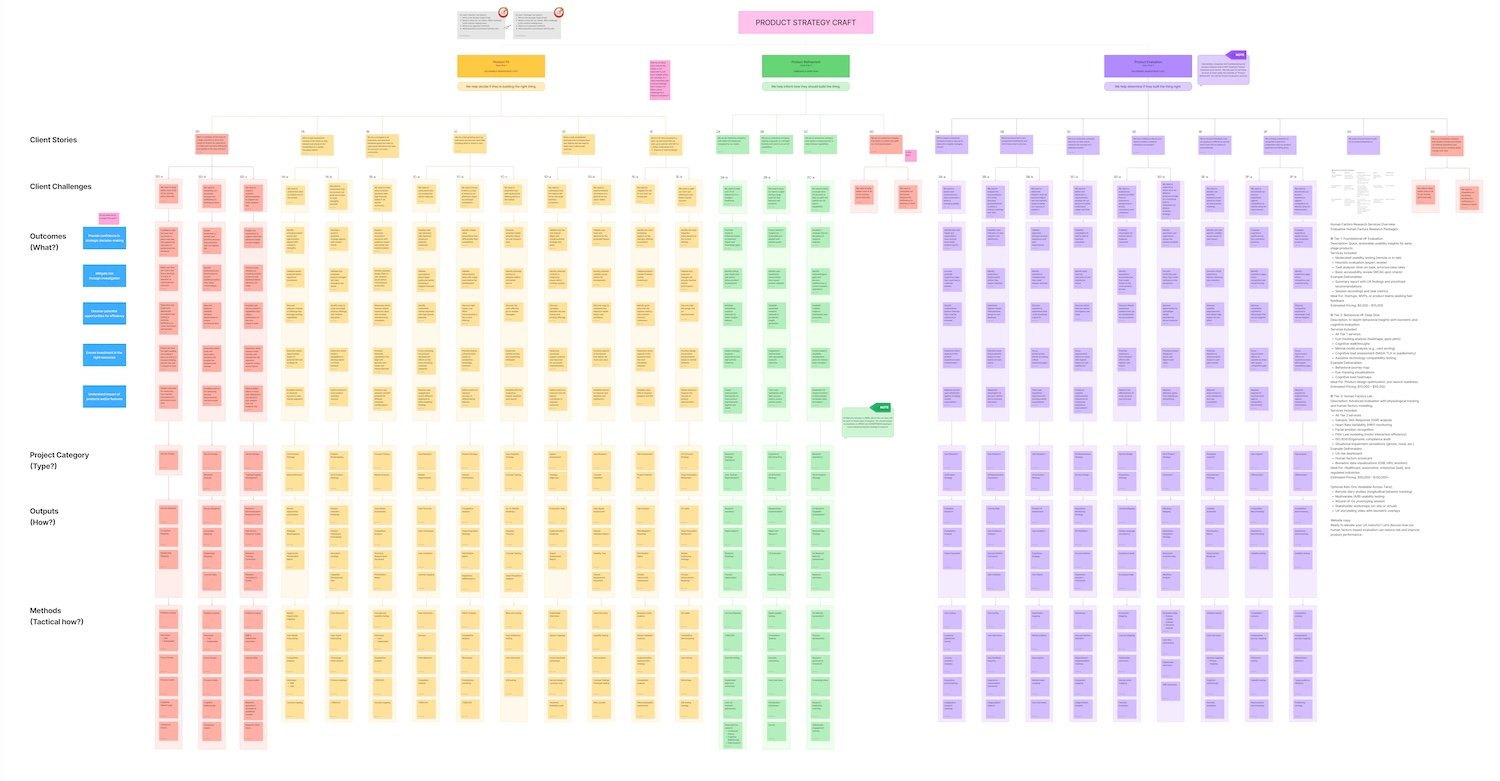
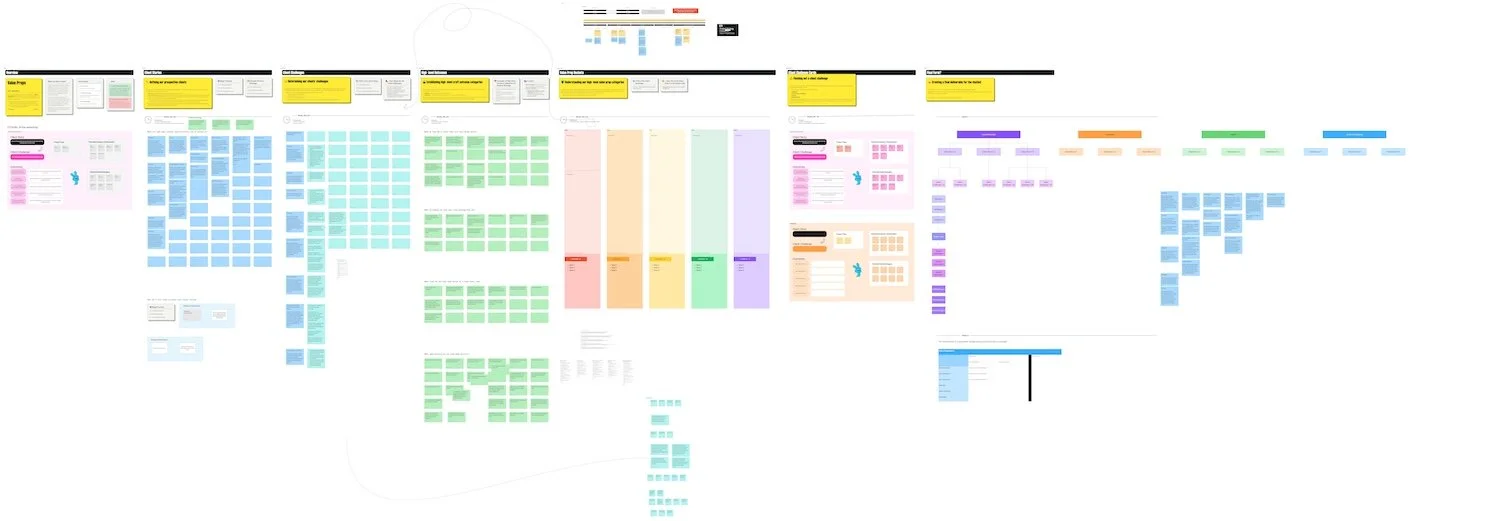
Scaling the Approach (Currently In Progress): After ELT mandated that all crafts develop value propositions using my framework, I designed and am currently facilitating workshops for senior leaders across Design, Industrial Design, Design Technology, and Development. Rather than simply hand off my research templates, I'm guiding each craft through the thinking process and helping them adapt the problem-first, outcome-focused approach to their unique capabilities and client challenges.Stewardship in Action: I designed these value propositions as durable infrastructure that would outlast leadership transitions and support the organization's growth. By documenting our rationale and decision-making process, I created artifacts that current and future leaders could build upon rather than recreate from scratch.
-
Immediate Business Impact:
Full Team Utilization: As of now, my entire research team is allocated to projects. This is a direct result of more effective business development supported by the Value Props
Leadership Enablement: ELT and senior leadership have independently recognized research opportunities and scoped research into 4-6 projects in Q3 without requiring me to be in the room
Revenue Growth: Members of senior leadership have referenced the value props to scope and upsell research on in-progress and prospective client projects, leading to an increase in research opportunities
Team Development Impact: Full team allocation means researchers have consistent, meaningful project work, which is essential for skill development, job satisfaction, and retention. Team members can now articulate research value using the same language leadership uses, strengthening their professional growth narratives.
-
Organizational Transformation: The value propositions proved so effective that ELT mandated all crafts (Design, Industrial Design, Design Technology, Development) create value propositions using the same framework I developed. What started as a research-specific solution became the organizational approach to articulating craft value and strengthening our business development pipeline.
Leading Cross-Craft Implementation: I'm currently facilitating workshops to guide senior leadership from other crafts through the value proposition development process, adapting my research-focused approach into a repeatable methodology that works across disciplines. Rather than simply sharing templates, I'm teaching the strategic thinking behind problem-first, outcome-focused positioning.
Building Durable Infrastructure:
Established shared language across the organization for articulating craft value
Building a chatbot tool to make all craft value props more accessible and easier to use than the current FigJam flowcharts
Created durable frameworks that will outlast leadership transitions and support client growth and project diversification
What This Demonstrates: This project exemplifies how I lead at the intersection of strategy and people, and how strong leadership work scales beyond a single team. What started as solving a research bottleneck became the organizational standard for how all crafts articulate value. By creating a repeatable framework and leading other craft leaders through adaptation, I'm multiplying impact across the entire agency. I translated craft work into business language, proved its effectiveness, and now I'm enabling others to do the same.
“In the same way your heart feels and your mind thinks, you… are the instrument by which the universe cares. If you choose to care, then the universe cares. If you don't, then it doesn't.”
The Void, voiced by Brennan Lee Mulligan in DROPOUT.TV's Dimension 20: Fantasy High